
New Hyundai 7-Seater MPV 2026 in India: Price & Specs

Introduction: Hyundai’s Bold Move into the Family Car Segment
The Indian multi-purpose vehicle (MPV) segment is witnessing an unprecedented surge in demand. Modern Indian families want extra space, premium tech, and uncompromised safety without breaking the bank. While Maruti Suzuki Ertiga and Kia Carens have dominated this space for years, Hyundai is preparing to shake up the market with its fresh entrant. The arrival of the New Hyundai 7-Seater MPV 2026 in India marks a major shift in how affordable family movers are designed and delivered.
Hyundai has consistently set benchmarks in India with feature-packed cars like the Creta and Venue. Consequently, expectations for their upcoming 7-seater MPV are sky-high. Positioned strategically between compact family cars and premium three-row SUVs, this new MPV aims to combine futuristic aesthetics, practical cabin space, and advanced driver-assistance features.
In this comprehensive guide, we examine every known detail about the new Hyundai MPV. You will discover expected pricing, launch timelines, engine options, 5 dynamic color options, interior tech, and how it stacks up against key rivals.
What is the New Hyundai 7-Seater MPV 2026 in India?
Hyundai has been testing and fine-tuning its global MPV platform—famously known as the Stargazer in Asian markets—for Indian road conditions and buyer preferences. In India, Hyundai plans to adapt this versatile platform to deliver a localized, value-driven 7-seater MPV.
The vehicle bridges the gap in Hyundai’s portfolio between the sub-4-meter segment and the larger Hyundai Alcazar. By sharing core structural elements and powertrains with sister company Kia’s Carens, Hyundai can keep manufacturing costs low while offering distinct styling and feature packages.
Expected Launch Date and Price Range in India
Automotive industry reports indicate that Hyundai will reveal the production version in late 2026, with nationwide dealership deliveries commencing shortly thereafter.
Pricing plays a crucial role in the competitive Indian MPV market. Hyundai is expected to position this vehicle aggressively against established competitors.
| Variant Level | Estimated Ex-Showroom Price (INR) |
| Base Variant (1.5L Petrol MT) | ₹ 9.60 Lakh – ₹ 10.50 Lakh |
| Mid-Spec Variant (1.5L Petrol iVT/AT) | ₹ 11.50 Lakh – ₹ 13.50 Lakh |
| Top-Spec Variant (1.5L Turbo / ADAS) | ₹ 14.50 Lakh – ₹ 17.00 Lakh |
| Factory CNG Variant (Expected) | ₹ 10.80 Lakh – ₹ 12.20 Lakh |
Note: Prices are estimated ex-showroom India and subject to official Hyundai announcements at launch.
Exterior Design: Futuristic Styling Meets Practicality
Unlike traditional boxy MPVs, Hyundai adopts a sleek, aerodynamic silhouette inspired by its global flagship MUVs. The front fascia features a full-width horizontal LED light bar, creating an unmistakable road presence.
Key Exterior Highlights
- Parametric Front Grille: A large, chrome-detailed grille flanked by vertically stacked LED headlamps.
- Dynamic Side Profile: Pronounced wheel arches with stylish 16-inch or 17-inch diamond-cut alloy wheels.
- Signature H-Tail Lamps: A connected LED taillight assembly across the tailgate that emphasizes the vehicle’s width.
- Functional Roof Rails: Integrated roof rails capable of holding luggage carriers for extended road trips.
- High Ground Clearance: Estimated 185 mm ground clearance to comfortably navigate rough Indian roads and speed breakers.
5 Striking Color Options for the New Hyundai MPV
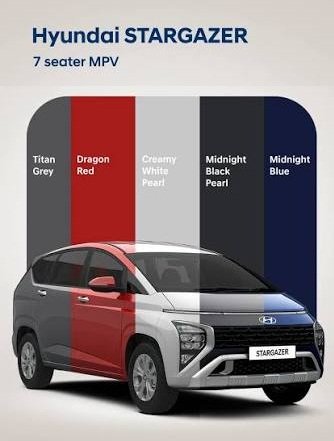
Hyundai understands that color options play a critical role in buyer decisions across Indian households. To suit diverse tastes—ranging from understated elegance to sporty flair—the MPV is expected to roll out in 5 primary shade options:
- Titan Gray Metallic: A rich, sophisticated dark grey shade that highlights the body lines while resisting visible road dust—ideal for urban commuters.
- Creamy White Pearl: A timeless, high-gloss white shade that reflects sunlight efficiently, keeping cabin temperatures cooler during hot Indian summers.
- Midnight Black Pearl: A deep, premium black shade that gives the futuristic front grille and LED light bar a stealthy, high-end appearance.
- Magnetic Silver Metallic: A sleek, low-maintenance metallic silver that delivers an elegant metallic shine in bright daylight.
- Dragon Red Pearl: A bold, vibrant red designed for buyers who prefer a distinctive, sporty presence on the highway.
(Select higher trims are also anticipated to offer dual-tone combinations featuring a contrast black roof.)
Interior Cabin, Space, and Comfort Features
Step inside, and Hyundai’s signature interior craftsmanship becomes immediately clear. The cabin layout prioritizes driver ergonomics and passenger comfort across all three rows.
Seating Configuration Options
Buyers can choose between two distinct cabin seating layouts:
- 6-Seater Layout: Features plush middle-row Captain Seats with individual armrests and slide/recline controls for executive comfort.
- 7-Seater Layout: Offers a 60:40 split bench in the second row with a one-touch tumble mechanism for quick access to the rear seats.
Dashboard and Infotainment Technology
- Dual 10.25-Inch Screens: A seamless glass pane housing both the digital instrument cluster and touchscreen infotainment unit.
- Hyundai Bluelink Connected Car Tech: Over 60 connected features including remote engine start, AC control, geofencing, and SOS alerts.
- Wireless Connectivity: Standard wireless Apple CarPlay and Android Auto support across mid and high trims.
- Bose Premium Audio: An optional 8-speaker Bose sound system engineered specifically for multi-row acoustic cabin spaces.
Performance, Engine Options, and Transmission
Under the hood, the New Hyundai 7-Seater MPV 2026 in India will leverage Hyundai’s proven, refined powertrain lineup. These engines deliver an optimal balance between city drivability and highway cruising capability.
1. 1.5-Litre Naturally Aspirated Petrol
- Power: 115 PS @ 6,300 RPM
- Torque: 144 Nm @ 4,500 RPM
- Transmissions: 6-Speed Manual / Intelligent Variable Transmission (iVT)
- Target Mileage: 16.5 – 17.8 km/l
2. 1.5-Litre Turbocharged Gasoline (TGDi)
- Power: 160 PS @ 5,500 RPM
- Torque: 253 Nm @ 1,500 – 3,500 RPM
- Transmissions: 6-Speed iMT / 7-Speed Dual Clutch Transmission (DCT)
- Target Mileage: 15.0 – 16.5 km/l
3. Factory-Fitted Dual-Cylinder CNG (Expected)
To counter high fuel costs, Hyundai is developing a dual-cylinder CNG setup that preserves usable boot space while delivering a fuel efficiency exceeding 26 km/kg.
Safety Tech: Level-2 ADAS and Standard Safety Net
Hyundai continues to prioritize occupant safety. The manufacturer plans to equip this 7-seater MPV with Hyundai SmartSense (Level-2 ADAS) on higher trims, making it one of the safest MPVs in its price bracket.
Standard Safety Features Across All Variants
- 6 Airbags (Front, Side, and Curtain)
- Electronic Stability Control (ESC) and Vehicle Stability Management (VSM)
- Hill-Start Assist Control (HAC)
- All-Wheel Disc Brakes
- ISOFIX Child Seat Anchorages
- Tyre Pressure Monitoring System (TPMS)
- Rear Parking Sensors with Dynamic Camera Guidelines
Advanced Driver Assistance Systems (ADAS Level 2)
- Forward Collision-Avoidance Assist (Car, Pedestrian, and Cyclist)
- Blind-Spot Collision-Avoidance Assist
- Lane Keeping Assist and Lane Following Assist
- Rear Cross-Traffic Collision-Avoidance Assist
- Adaptive Cruise Control with Stop & Go
- High Beam Assist
Head-to-Head Comparison: Hyundai MPV vs. Competitors
To make an informed purchase decision, let us compare Hyundai’s upcoming MPV against current market leaders in India.
| Feature / Spec | New Hyundai 7-Seater MPV 2026 | Maruti Suzuki Ertiga | Kia Carens |
| Expected Price | ₹ 9.60L – ₹ 17.00L | ₹ 8.85L – ₹ 13.00L | ₹ 10.50L – ₹ 19.50L |
| Engine Options | 1.5L Petrol / 1.5L Turbo / CNG | 1.5L Petrol / CNG | 1.5L Petrol / 1.5L Turbo / 1.5L Diesel |
| Max Power | Up to 160 PS | 103 PS | Up to 160 PS |
| Color Choices | 5 Distinct Options + Dual Tone | 6 Mono-tone Options | 7 Options |
| ADAS Availability | Yes (Level 2) | No | Yes (Level 1/2) |
| Ventilated Seats | Yes (Front) | No | Yes (Front) |
| Touchscreen Size | 10.25-inch | 7.0-inch | 10.25-inch |
Practical Buying Tips for Prospective MPV Buyers
Buying a 3-row family vehicle requires evaluating daily family needs against long-term operational costs. Here are essential tips before booking your vehicle:
- Pick the Right Exterior Color: If you drive frequently in dusty areas, Titan Gray Metallic or Magnetic Silver Metallic are easier to maintain than darker shades like Midnight Black.
- Evaluate Middle-Row Needs: If elderly family members travel frequently, opt for the 6-seater variant with Captain Seats for easier entry and egress.
- Calculate Annual Mileage: Choose the 1.5L naturally aspirated petrol or CNG variant if your primary usage is city commuting. Select the 1.5L Turbo Petrol for frequent long-distance highway trips.
- Check Boot Space with 3 Rows Up: Ensure the vehicle retains enough luggage room for small bags when all seven seats are occupied.
Conclusion & Call-to-Action
The New Hyundai 7-Seater MPV 2026 in India is set to redefine family mobility by combining striking design, 5 dynamic color options, advanced safety features, and flexible cabin spaces at a competitive price point. Whether you need a comfortable daily commuter or a feature-packed highway cruiser for family road trips, this upcoming MPV deserves a top spot on your watchlist.
Are you planning to upgrade your family car in 2026? Subscribe to our automotive newsletter to receive instant launch alerts, real-world test drive reviews, and exclusive booking offers as soon as official registrations open!
FAQ Section
Q1: What color options are available for the New Hyundai 7-Seater MPV 2026 in India?
The Hyundai 7-seater MPV is expected to come in 5 distinct color options: Titan Gray Metallic, Creamy White Pearl, Midnight Black Pearl, Magnetic Silver Metallic, and Dragon Red Pearl.
Q2: What is the expected starting price of the New Hyundai 7-Seater MPV 2026 in India?
The starting ex-showroom price is expected to be around ₹ 9.60 Lakh for the base petrol variant, going up to ₹ 17.00 Lakh for top-end turbo automatic models.
Q3: Will the Hyundai 7-seater MPV come with a CNG option?
Yes, Hyundai is expected to offer a factory-fitted dual-cylinder CNG option on select mid-level variants to provide high fuel efficiency without compromising luggage capacity.
Q4: How does the Hyundai 7-seater MPV compare in size to the Maruti Ertiga?
The Hyundai MPV is expected to be slightly wider and feature a longer wheelbase than the Maruti Suzuki Ertiga, providing enhanced shoulder room and legroom across all three rows.
Q5: Does the new Hyundai 7-seater MPV feature ADAS safety technology?
Yes, top-spec variants will come equipped with Hyundai SmartSense Level-2 ADAS, including Autonomous Emergency Braking, Lane Keep Assist, and Adaptive Cruise Control.